KELLI RAE POWELL: REDEFINING EVERYTHING YOU THOUGHT YOU KNEW ABOUT THE UKULELE

I’ve had to take a hiatus from Apsara for several months, but couldn’t pass up the opportunity to interview folk artist Kelli Rae Powell, whose latest album has taught me more than a thing or two about the versatility and beauty of the ukulele.

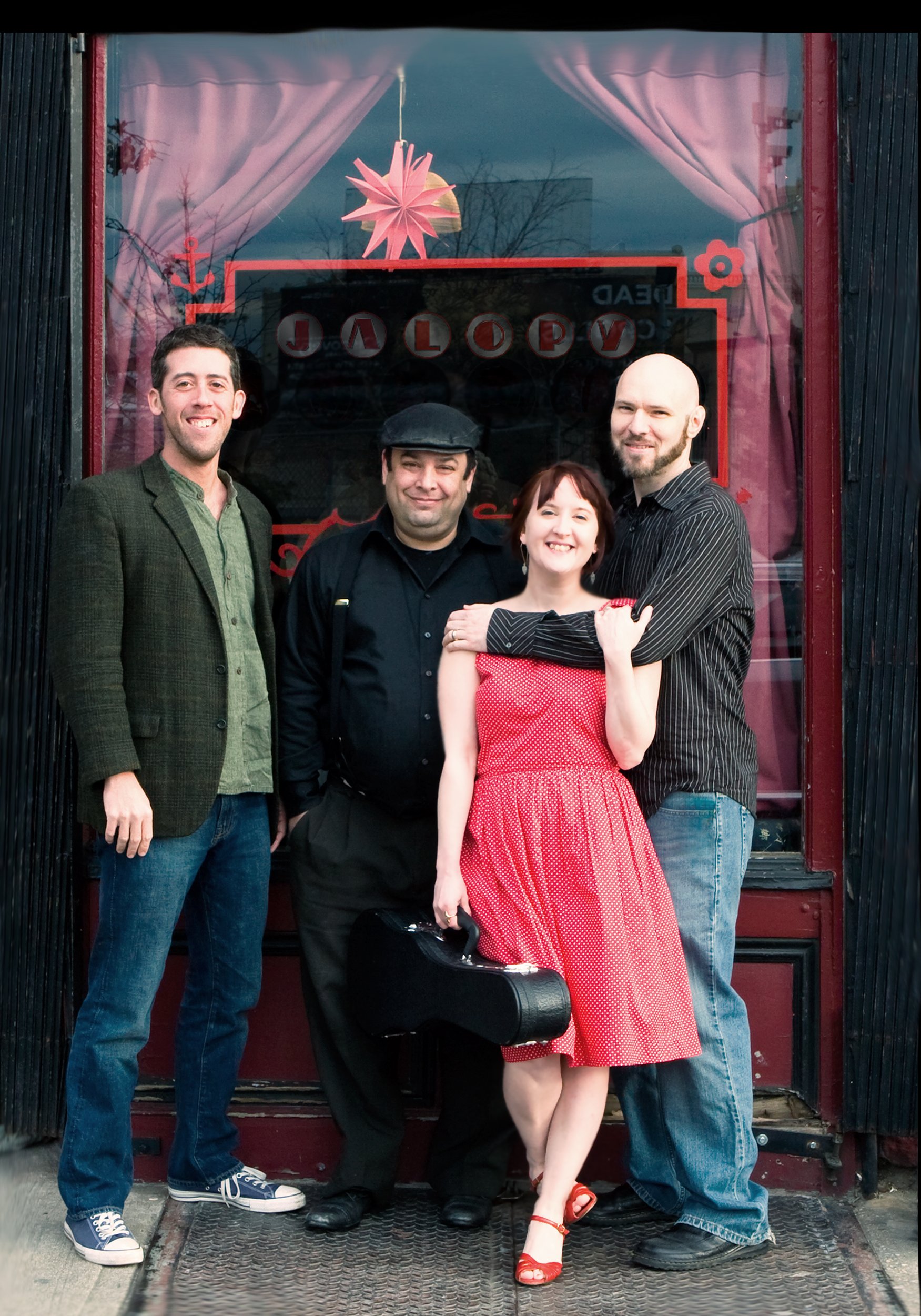
Joe Brent, mandolin; Shaky Dave Pollack, blues harp; Kelli Rae Powell, voice and uke; and Jim McNamara, upright bass. (courtesy the artist)

Joe Brent, mandolin; Shaky Dave Pollack, blues harp; Kelli Rae Powell, voice and uke; and Jim McNamara, upright bass. (courtesy the artist)

Think you know the ukulele? Meet folk singer-songwriter Kelli Rae Powell, who since 2003 has made this much misunderstood “baby guitar” her instrument of choice.

Cradling it in her arms, Powell knows how to bring out the best in her ukulele. Its gentle tones nimbly carry the melody for her sweet, yet powerful voice on solos, and adeptly serves as lead instrument in an ensemble of blues harp, upright bass, and mandolin.

Powell, an Iowa-native now living in New York, draws inspiration from Dolly Parton and Billie Holiday for the musical poems about life that she weaves. Her latest album Live at Jalopy, is a flawless offering of wit and sensitivity, which also captures a special evening in Powell’s life at Brooklyn’s Jalopy Theatre and School of Music.

In a recent interview, Powell describes her love of the ukulele and her favorite music venue, and shares about the exciting next chapter of her life.

The ukulele is perhaps one of the more misunderstood, and underappreciated instruments. When did you first encounter the ukulele, and what about this instrument led you to make it a focus of your music?

In 2003, I acted in a play and the director wanted my character to play ukulele. I loved performing with the uke so much that I just couldn’t stop. The ukulele fits in my arms perfectly. I love its small size, its portability, and the beauty of its sound. No one expects the poignant tones a ukulele can make.

In my angry twenties I would go to open mics wielding my little uke and the guitar boys would always make fun of me, saying: “What a cute baby guitar!” They all shut their traps when it was my turn to perform, though. That was fun.

There seems to be strains of jazz, blues, and folk influences in your music—who are the musicians who most inspire you?

When I was very young, I used to listen to Dolly Parton on my record player. Then I would tape myself singing her songs and play them back I was listening to myself and trying to sound just like her. In high school I had a CD of Billie Holiday’s Verve recordings. I listened to that album every day for probably three years. Those women shaped my taste in music more than any other artists I can think of. They are storytellers of the highest order.

Kelli Rae Powell's Live at JalopyHow did you come to record a live album at Jalopy, and what about this venue provided the right backdrop for it?

My first performance at Jalopy was in the midst of a huge blizzard. I opened for songwriters Al Duvall and Bliss Blood. We all trudged through the snow towards Red Hook [Brooklyn] fairly certain there wouldn’t be anyone at our show. Jalopy didn’t have a liquor license at that time, so we brought bottles of red wine. We basically played for each other all night and drank as the snow piled up around us. It was magical. The owners Lynette and Geoff Wiley never seem to care about how many people you can draw. They like my songs, so they let me book shows there.

The audience at Jalopy is extremely respectfulthey come for the music. They sit in the old church pews and listen to your stories. There isn’t any other venue for me in the world. When I gathered the courage to record a live album, there was no question that I would record it at the Jalopy Theatre and School of Music.

Your songs range from beautiful, simple descriptions of the first moments of falling in love, to more humorous reflections on living and loving. Are you drawing on your own experiences, or more generally on the stories of others?

These are my stories. Some of the details will be slightly altered for dramatic effect or to protect the innocent, but, even if the details aren’t necessarily true, the stories are. The songs on this live album are the songs I wrote about losing my grandmother and finding my husband Jim (my husband Jim McNamara is the upright bass player on this recording and on my previous album New Words For Old Lullabies).

The experience of recording this album was an absolute celebration for Jim and me. Our favorite musicians joined us on stage that night: Shaky Dave Pollack on blues harp and Joe Brent on mandolin and violin. The occasion was made doubly special, because just days before the live recording we learned we were pregnant. We were giddy that we captured that special night.

What project are you planning next?

My next album will probably be full of lullabies written for my little girl. I’ve already written a bundle for her.

“Some Bridges are Good to Burn”

Posted in Feature | Tagged , | Leave a comment

WE CAN WIN: NEW ACOUSTIC ALBUM BY BADU BOYE

Some albums take a while to warm up to, but every so often I come across one I know is going to be a fixture in my music collection for a long time. The first few bars of harmonica on Senegalese singer-songwriter Badu Boye’s new release We Can Win decided it for me.

"We Can Win" by Badu BoyeBadu Boye’s open-hearted harmonica, guitar, and vocals on We Can Win evoke Bob Dylan at his best in the early 1960s, but with a thoroughly contemporary edge incorporating electric guitar, bass, drums, trumpet, violin, cello, mandolin, and other instruments. Composed individually, the songs represent different musical moments from over a decade, including  “Mboolo Mi” from the 1997 album Woyou Talibé, which Badu released with Pape Armand Boye, his brother and the producer of We Can Win.

The Boye brothers debuted on Senegalese television in the early 1990s with a sound that was a bit different during a time when synthesized mbalax music dominated the airwaves: a simple pairing of acoustic guitar and bass. Through their ground-breaking early performances and recordings, they led the establishment of acoustic music as a genre still thriving today in Senegal.

A current of optimism runs throughout We Can Win, not least of all in the title track’s call for positive development and image building across Africa. “Everything single thing I do is to make you proud,” Badu sings. “I know that we can win—yes we can.” On “Senegal,” one of the album’s very strongest tracks, he describes the experience of living abroad while still cherishing the country he has left behind: “Everything is beautiful, but I’m homesick for Senegal my country. I’m sure that one day I’ll be back!”

“Senegal”

The album’s arrangements are layered around Badu’s signature harmonica and acoustic guitar, and are filled with bursts of shimmering, beautiful sound when you least expect them. Sukjong Hong’s violin catches you unawares with its pure sweet sound on “Politique,” while Will Martina’s cello ripples in and out of the melody toward the end of “Mboolo Mi.” Of all of the tracks though, the loveliest of all perhaps is “Melokaan,” a simple arrangement with Badu’s brother joining him on acoustic guitar.

We Can Win is one of those albums I pull out when I need a gentler perspective on life after a harsh day, and more than deserves its place as a long-term fixture in my music collection. Samples of the tracks can be previewed on Badu’s website.

Posted in Review | Tagged , , | Leave a comment

SIMPLY GOOD REGGAE: GONDWANA AND BOB MARLEY’S WAILERS PERFORM TOGETHER IN SAN FRANCISCO

Fifteen minutes after San Francisco’s Mezzanine opened its doors for the evening last Thursday, I could already tell it was well worth staying out late on a weeknight to hear Chilean reggae stars Gondwana and the legendary Wailers perform.

Aston Barrett with a new generation of Wailers (courtesy the artists)

Reggae music fans steadily filled the club over the next half hour. Some congregated around the bar ordering drinks or chatting, while many danced to the mix of reggae, world music, and hip hop spun by San Francisco-based DJ Julicio. In a far corner, a vendor pulled toasted empanadas from a small portable oven for hungry audience members.

Beneath the friendly, laidback vibe, excitement stirred as the dance floor filled with more and more people. Gondwana entered Mezzanine around 10 PM, skirting the edge of the dance floor on their way backstage. One fan raced after them, grinning from ear to ear as band members stopped to pose for a photograph and shake hands with him outside the stage door.

When Gondwana came out a short while later, the audience went wild and pressed closer to the stage. The band’s performance hung together nicely, with ballads such as “Piensame” and crowd-pleasing numbers like “Irie.” Only the electric guitar-charged “Revolucion”—a surprisingly intense song—stood out a little.

Gondwana’s band members clearly love performing together and interacting with their audiences, and their energy spread throughout the crowd at this concert. Their Bay Area fans turned out in full force for the show, but whether people came specifically for Gondwana or for the Wailers didn’t matter. Those who knew the lyrics sang along with Gondwana’s MC Jona, and everyone else enjoyed dancing. The crowd came to the show, first and foremost, for good reggae.

After Gondwana closed with a rendition of the Wailers’ “Could You Be Loved,” DJ Stepwise, a Bay Area-based DJ and producer, came out and played a 30-minute set of classics-heavy roots reggae and dancehall. Mezzanine was fully packed by the time he wound down, but there was still enough space to dance and the good-natured energy of the audience kept flowing.

The Wailers stepped out onto the stage to an explosion of cheers and whistles. After warming up with an all-instrumental set and performing numbers from their mid- to late-1970s repertoire such as “Roots Rock Reggae” and “Natural Mystic,” the band moved into the “standards” known and beloved by all, including “I Shot the Sherriff” and “Stir it Up.” The evening’s crowning moment was, of course, the entire club singing “One Love” together.

Even with a new lineup of younger members, including lead singer Koolant, it felt throughout the show as if Bob Marley was there with the band too. Bassist Aston “Family Man” Barrett,  who originally performed with Marley, still plays with the group with undiminished energy and a steady hand, and the music hasn’t lost any of its original spirit.

There’s something to be said for a band that continues to draw large enthusiastic audiences after four decades—that’s the hallmark of good music. And whether we realize it or not, we all have Wailers lyrics stored away somewhere in the depths of our subconscious, and to have a chance to sing along at an actual Wailers concert is an experience not soon to be forgotten.

Gondwana performs Bob Marley and the Wailers’ “Concrete Jungle”

The June 7 Gondwana-Wailers concert was presented by Earshot Entertainment. 

Posted in Review | Tagged , , , , | Leave a comment

RED PLANET: TAKE TIME TO GET TO KNOW ARBOREA

Somewhere between electro-acoustic and folk, and between forest and ocean, emerges the music of Arborea, a husband-and-wife duo from Maine.

Arborea: Shanti and Buck Curran (courtesy the artists)

Since releasing their first album Wayfaring Summer in 2006, Buck and Shanti Curran have toured regularly across the United States and Europe, absorbing sounds and experiences along the way that filter into their music.

Red Planet (Strange Attractors Audio House, 2011), Arborea’s most recent album, conjures images of barren landscapes and misty forests; of sunny afternoons and contemplative hours; and the happy, although swift, passage of time.

The minor key and atmospheric electric guitar of tracks like “Phantasmagoria in Two” and “Wolves” lends a touch of mystery to the album, which is balanced by the lighter sounds of “Spain” and “A Little Time.”

Buck and Shanti both skillfully play a large number of instruments—guitar, banjo, and harmonium to name only a few—and Red Planet features a handful of instrumental tracks, such as “Fossil Sea.” Shanti sings on most of the songs though, in a warm, sweet-sounding voice at times tinged with plaintiveness.

Arborea’s music is captivating and unconventional in a way that keeps you wanting to experience more, and it’s well worth setting aside some time to listen to one of their albums.

Already this spring, the duo has performed at SXSW and on NPR for a Tiny Desk Concert. They took time out of their busy schedule, which includes touring and homeschooling their two children, to catch up with Apsara in an e-mail interview.

Arborea’s music has been dubbed as “psych folk,” “indie folk,” etc. How would you describe it? 

We’ve been called “avant folk,” “indie folk,” “psych folk,” “dream folk,” “free folk,” “folk rock”…but it’s not strictly folk. With elements of rock, blues, and Eastern modal music, you might describe it more as “soundscapes.” More often than not, our music is created as if it were a soundtrack for the landscapes and environments we’re moving through or interacting with, so it’s really impossible to say it’s just one thing. A lot of people associate us with forests and mountains, but we’re equally inspired by the power of the ocean and the rugged coast of Maine, as well as countries we often visit: Ireland and Wales, Italy, Spain, and Portugal.

Your first album Wayfaring Summer came out in 2006, and you recently released your fourth album Red Planet. In what ways has your music evolved over this span of time?  

Our music has evolved quite a bit over the past seven years. We’ve gotten so much stronger and intuitive as a duo because we’ve dedicated everything we have to playing music and spend most of our time each year touring throughout the US, UK, and Europe. We heard a term recently in an old interview with Marc Bolan (T. Rex), in which he talked about the reality of life as an artist and touring, and how you don’t make a lot of money. But you do it because you “live your environment”—and that’s exactly what we do.

Red Planet features renditions of “Black is the Colour” and “Careless Love” alongside your own compositions. How did you approach interpreting these traditional songs, which have been performed by musicians from many different genres?

“Careless Love” is actually two distinct traditional songs. One version is a folk song about pregnancy, and the other is a blues song about frivolous love (Bessie Smith recorded a notable version in 1925). It’s origin though is an anonymous poem. Shanti randomly discovered the short poem in an old literature book and at the time we didn’t know about the other versions. We took words from the poem, then composed the song with our own rhythm, melody, and song structure. Our song is linked closer to the folk song, with the references to young love and pregnancy, and wearing the apron high and low.

“Black is the Colour” is our own arrangement of a version that’s on the 1987 Martin Simpson and Jessica Radcliffe album True Dare or Promise. That song was passed down to Jessica from her mother, and most likely the source of the version that’s best known comes from the American composer and collector of traditional ballads John Jacob Niles. It’s a song with Scottish origins, brought to the Appalachians by immigrants from Scotland. The River Clyde in Glasgow is referenced in the lyrics and shows direct lineage to Scotland. We also have a version of “This Little Light of Mine” that we recorded for an Odetta tribute. Interpreting traditional songs can be a really fluid process and a lot of fun, because you have a solid reference point from which to start. Our approach is quite simple because the framework of the song is established. We can then improvise with all the existing parts: varying the melody, removing words, and adding new ones. One thing that’s of great importance to us is making sure that there’s plenty of space in the recording so the melody can shine through. That’s how we try to produce all of our music though, not just traditional songs.

This month, you performed a lovely, three-song Tiny Desk Concert at the NPR headquarters. What was this experience like?

We had such a great time! Bob Boilen and all of the crew at NPR are really down to earth and professional, so it made for a relaxing, fun experience. We homeschool our kids, and they were on tour with us and also got to see the NPR headquarters. After our session, NPR let us keep our van in their garage, so we took an amazing family walk around Washington, DC, and eventually ended up at the Air and Space Museum.

Arborea on NPR Music

Posted in Feature | Tagged , , , , | Leave a comment

POWER AND PEACE: JEF STOTT ACHIEVES PERFECT BALANCE WITH ARCANA

Jef Stott’s new album Arcana invites listeners to follow a strong, snaking bass line to a place of skillfully balanced power and peace.

A female voice mingles with a buzzing bass line for a few moments and then crescendos through and above it on “Deep Playa,” the opening track of Arcana, San Francisco-based musician Jef Stott’s latest album.

Throughout the entire recording, Stott merges vocals  and acoustic instrumentals—at once ageless- and ancient-sounding—with electronic beats and percussion loops. He pairs the future with the past and strength with sensitivity, revisiting many previous collaborations along the way.

“This album is like a scrapbook of my whole career,” said Stott during a recent interview. “Sonja Drakulich from Stellamara is on it, for example, and she and I hadn’t worked together in more than 10 years. There’s also some motifs from earlier pieces that I’ve written.”

Stott, who has been releasing albums since the late 1990s, never completely stepped away from music while pursuing a career path in a different direction and a master’s degree in interactive media. But Arcana represents his renewed focus on music after life dealt him a series of blows, and symbolizes his coming back to the beginning and re-gathering strength.

“The sound of the album is me artistically and personally reclaiming space,” he said. “It’s letting the world know—and letting myself know—that I’m still here and that I still have something to say.”

Arcana draws on Stott’s years of expertise in Middle Eastern music, including studying with oud virtuoso Hamza El Din, and on his success as a DJ at festivals like Burning Man. But at the album’s heart is actually a much earlier and simpler musical experience.

“I started playing guitar when I was around 11 or 12 years old, and went through all of the permutations—punk rock, heavy metal, and all sorts of different things,” he said. “For Arcana, I started working with acoustic guitar.”

Jef Stott playing oud (courtesy the artist)

Stott built upon this six-string foundation with lush, synthesized sounds and with skillful juxtapositions and looped recordings of talented friends like singer MC Rai, tabla player Jason McKenzie, and multi-instrumentalist Eliyahu Sills. On “Hero’s Return,” for example, Stott interspersed segments of Sills playing bansuri, an Indian bamboo devotional flute, throughout the track.

“There was a lot of editing in the bansuri parts because I didn’t want it to overpower the song,” he said. “I had to find just little pockets and phrases that were going to complement the melody.”

The intense bass line from “Deep Playa” snakes its way throughout Arcana, stopping short of the final track “White Tara.” Compared with his earlier recordings, the powerful sound of Arcana may take some listeners by surprise.

“I kind of stepped out of the shadows on this one,” Stott said. “What I was trying to do was just to be really open and lay it all out emotionally—that was my main goal with this record.”

Even with the bumpy road Stott encountered before recording the album—or perhaps because of it—Arcana presents a perfect balance of power and peace. It tells the story of coming full circle, and of honoring the past while welcoming the future.

Arcana is now available on Six Degrees Records.

Preview of Arcana


Posted in Review | Tagged , , , , | Leave a comment